Shyam Sekhar
I build platforms end-to-end — distributed systems, cloud-native infrastructure, and the SRE tooling that keeps multi-tenant SaaS reliable. Behind that: ~5 years at CareStack automating a sharded, multi-region healthcare platform, alongside a set of flagship systems I've designed and shipped solo. Each entry below is what it does, the stack, the engineering that matters, and why.
Flagship Personal Platforms
NeuralOps
Built / owned Document-Driven Agentic Ops Platform · Self-Hosted KubernetesA self-hosted Kubernetes platform in two layers: a Redis-backed task engine (priority queues, retries, dead-letter, cost-aware autoscaling) and an AI agent on top. Describe an operation in plain English and the agent either answers it — a read-only, human-approved query that returns a result and writes nothing — or changes something: it drafts schema-checked code, waits for human approval, and opens a real GitHub pull request. It follows an authored runbook when one fits and plans the change itself from the schema when none does, either way through the same guardrails. It drafts; it never applies to production on its own.
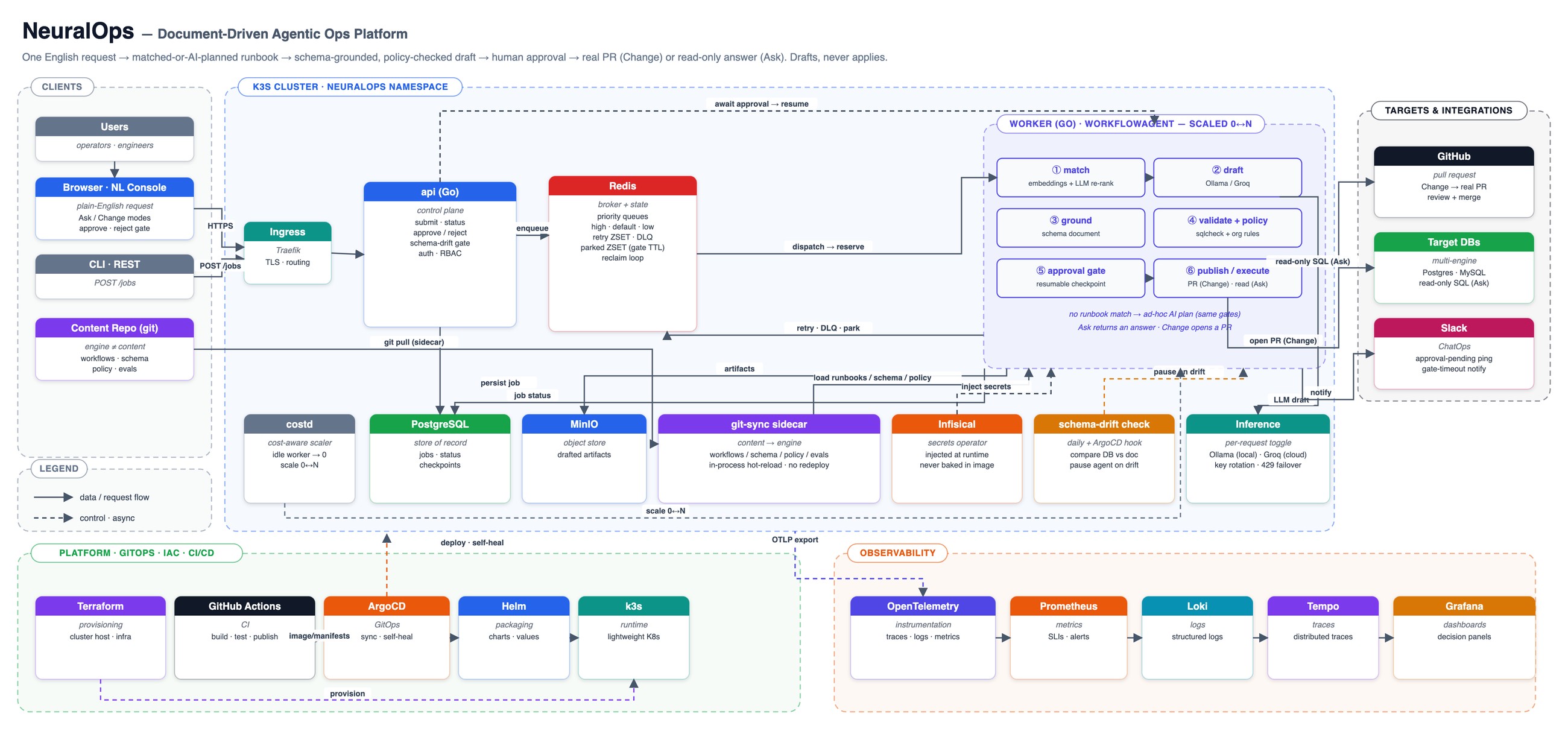
- Distributed task engine (Go + Redis): priority queues (high/default/low) with weighted draining, exponential-backoff retries with jitter, a dead-letter queue, and at-least-once delivery backed by a crash-recovery reclaim loop. Load-tested at 728 enqueue requests/sec, 0% errors, ~10 ms median on a single replica.
- The AI agent runs as a resumable job: it matches your request to a runbook (embeddings shortlist → LLM re-rank by intent) or, when none fits, plans the change itself from the schema — down the identical pipeline of validation, policy, human approval, and PR-only. It drafts step by step and pauses at every approval gate — checkpointed, so a run survives a closed browser or a worker restart. Read-only "Ask" requests take the same gate but return an answer instead of a PR, and a change-shaped question typed in Ask is caught and offered a one-click switch to Change. Drafting runs on a per-request local (Ollama) or cloud (Groq) toggle with multi-key rotation and 429 failover.
- Grounded in real schema, guarded against drift: generated SQL is grounded in a curated, multi-database schema document rather than live introspection; a daily check plus an ArgoCD post-sync hook pause the agent the moment the database drifts from that document, until it is reconciled.
- Org policy, an eval loop, and ChatOps around the AI: every drafted SQL artifact is checked against org-authored rules before a PR can open — no irreversible
DROP/TRUNCATE,GRANTonly to allow-listed roles, migrations must carry a rollback, no unboundedUPDATE/DELETE— with violations surfaced at the approval gate and in the PR body. A regression suite gates content-repo CI on a model bump, a live reviewer-decision metric flags runbooks whose drafts keep getting rejected, and a pending gate pings Slack with a review deep link — auto-cancelling if left undecided past a configurable timeout. - Full platform-engineering spine: k3s delivered via Helm + ArgoCD GitOps, Terraform, and CI; Prometheus / Grafana / Loki / OpenTelemetry for observability; a cost-aware daemon that scales idle workers to zero; secrets managed by the Infisical operator. Engine and content are fully separated — workflows and schema live in their own repo, pulled at runtime by a git-sync sidecar with in-process hot-reload, so content changes ship with no rebuild or redeploy.
▸ Design decisions & lessons from production
The architectural decisions I made building this, and the production issues that shaped them.
- Human-gated, resumable jobs over blocking a worker: approval is a durable checkpoint (
waiting_approval), not a held goroutine — a run survives a closed browser and a worker restart. That one primitive is what lets the whole agent run as a platform job. - Embeddings alone mis-routed intent — "list all tables" once matched DROP TABLE. I added a retrieve-then-LLM-rerank stage that selects by intent rather than forcing the nearest match, so a benign read never silently drafts a destructive change.
- A runbook shouldn't be the price of admission. Backing up a table shouldn't require a pre-authored runbook. The safety floor is human review + PR-only + validation + policy — none of which depend on the runbook — so when nothing matches, the agent plans the change from the schema and runs it through the same gates. Authored runbooks still take precedence when they fit; ad-hoc planning fills the gap. On the read side, the mirror: a change-shaped prompt typed in Ask ("back up …", "how to migrate …") is detected and redirected to Change rather than quietly drafting a
SELECT. - Grounding from a committed schema document, not live introspection: deterministic, reviewable, and it carries column meaning. A drift check pauses the agent when the database diverges from the document, so reconciliation is a deliberate review of the document rather than a scramble against a live schema.
- A strict engine/content boundary, proven live: I pushed a new workflow to the content repo and a running worker served it in about a minute with zero restarts (git-sync sidecar + atomic hot-swap).
- An operator that cached a dead credential: a persistent 401 that
curlproved was a valid key. The Infisical operator had cached the bootstrap secret and only cleared it on restart; I root-caused and documented it. - exFAT meets distroless: baked files arrived mode 0700 owned by root, so the nonroot container couldn't read them and crash-looped. Fixed with
COPY --chmod— a failure mode that only surfaces on a real deploy. - Measuring honestly: a poor P99 in the first load test turned out to be
kubectl port-forwardserializing traffic, not the api (728 req/s in-cluster vs 436 through the proxy). The real tail is the synchronous Postgres store-of-record write — durability chosen over enqueue-tail latency, and surfaced rather than hidden.
MedXCore
Built / owned AI-native Practice Management System · EMR for small clinicsAn AI-native practice-management system and EMR for small clinics (≤5 doctors) and solo practitioners — capture, schedule, and follow up in one system. Every doctor belongs to a clinic account; live at medxcore.osforlife.in.
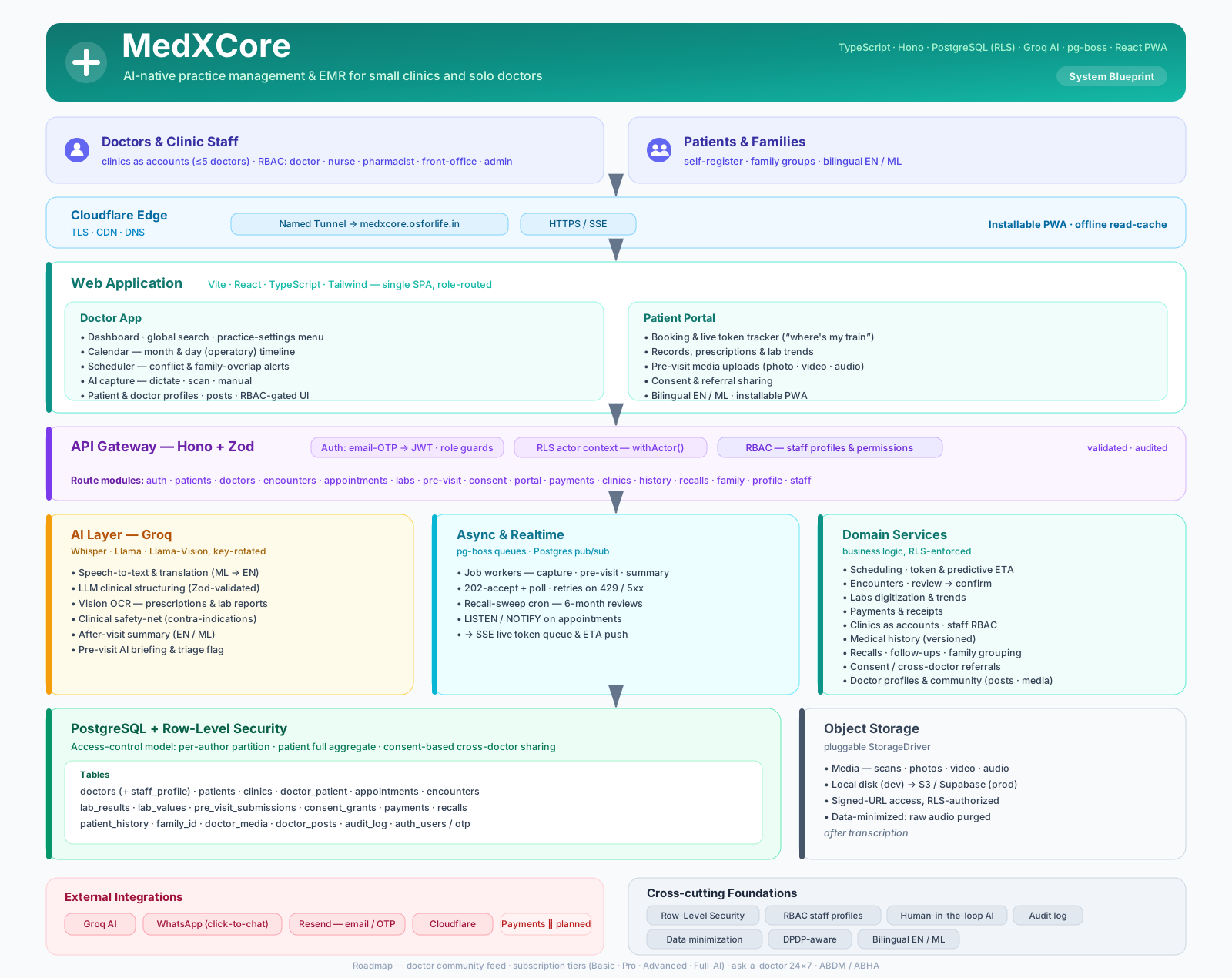
- AI clinical capture — Groq Whisper voice dictation, Llama-Vision OCR of paper prescriptions and lab reports, and manual entry, all funnelled through a human-in-the-loop review → confirm loop; auto after-visit summaries (English + Malayalam), pre-visit AI briefings, and a clinical safety-net.
- Live token queue (“where's my train”) over Postgres LISTEN/NOTIFY → SSE, with a predictive ETA that blends the doctor's set per-patient time with a learned rolling average; async AI pipeline on pg-boss (202-accept + poll).
- Security-first data model — Postgres Row-Level Security partitions clinical data per authoring doctor with patient-controlled, revocable cross-doctor sharing; layered RBAC staff profiles (Doctor · Nurse · Pharmacist · Front-office · Super-admin · Custom); append-only audit log on every clinical write; raw audio purged after transcription.
- Scheduling & lifecycle — month + day (operatory) calendar with conflict-aware booking and a same-family overlap exception, versioned medical history, and a recall / 6-month review engine on a pg-boss cron; doctor community profiles (media + posts).
LifeOS
Built / owned AI-Assisted Cross-Platform Productivity · shipped to productionA cross-platform iOS + Android app that turns long-term goals into daily action — and it is shipped, in real users' hands.
- Modular NestJS backend (Auth · Goals · Habits · Insights); JWT auth with refresh-token rotation (reuse detection → revoke session family) and per-device sessions in Redis.
- LLM goal decomposition (goal → weekly milestones → daily actions) with schema validation before persistence; automated weekly insight generation.
- PostgreSQL time-series for habits/goals — streak calculation via gap-and-island window functions, rolling completion-rate aggregations on a (user_id, date) index.
- React Native app with shared logic + platform-specific UI; push notifications. Shipped to production with GitHub Actions CI/CD.
Personal Side Projects
StockMarket
Built / owned NSE Swing-Trading Signal DashboardA dashboard that scans NSE stocks and ETFs, generates swing-trade signals, paper-trades them, and backtests the whole strategy — end to end.
- Pipeline: yfinance OHLCV/fundamentals → EMA indicators → buy/sell/hold signals + fundamental score → portfolio tracker → paper-trading simulation → backtest engine.
- Two Docker services (Streamlit UI + a separate scheduler container, TZ Asia/Kolkata, persistent volume) — interactive vs batch separation.
- TTL cache shields the rate-limited data source from UI auto-refresh.
CodeNames Malayalam
Built / owned Realtime Multiplayer Web GameAn online multiplayer Codenames clone with a 1,000-word Manglish (Malayalam) word bank — playable in real time with friends.
- No custom backend — the database is the trust boundary. Row-level security + a masked board view ensure operatives never receive secret card colors (hidden information enforced server-side in Postgres).
- Game moves are atomic Postgres RPCs (cheat-resistant); Supabase Realtime fans out state to all players.
UPSC Study System — "Prayas"
Built / owned Semantic-Search Content PlatformA study platform that turns a syllabus-shaped notes library into a fast, searchable web app — in fact, the very site you are reading this on.
- Local embeddings (FastEmbed/ONNX, free/CPU) → semantic search; content + vectors synced to Supabase; the app reads content live.
- Render buildFilter separates content-publish cadence from code-deploy cadence — content commits never redeploy the app.
- CI validates content JSON on every push; password gate; secrets in the dashboard, never in the repo.
CareStack — Internal Platforms
Heimdall
Co-developed Internal TechOps Automation PlatformThe operational control plane behind CareStack's multi-tenant, sharded, multi-region dental SaaS — one place to automate service requests, data-patch workflows, incident tracking, and monitoring.
- Self-healing data-patch pipeline: parameterised request → pull script from GitLab → substitute env vars → pre-run validation gate → peer/lead review or risk-proportional auto-merge → on merge, GitLab CI pushes a queue message + uploads the script to Azure Blob → an Argo job dequeues and executes against the correct shard via Flyway → live status streamed → post-execution validation → automatic MR revert + compensating script on failure.
- Led Sev1–Sev3 incident response; blameless post-mortems; integrated the Support User Access Tool.
Deriviz
Co-developed Multi-Database ETL & Migration PlatformAn internal .NET Core ETL and migration platform that replaced the SSIS-based tooling used to migrate customers off competitor systems.
- Source-native stored procedures per engine behind a heterogeneous driver-abstraction layer.
- Staging hop (OneDB) decouples N sources from the target transform (N extractors + 1 transform vs N×M).
- Configurable scheduler, retry logic, execution audit; post-migration reconciliation (counts/checksums/invariants).
Patient Entity Deletion System
Built / owned Distributed Right-to-ErasureCompletely removes a patient and all of their data across several polyglot microservice databases — without breaking integrity, tenant isolation, or analytics.
- An idempotent, ordered saga (no 2PC across heterogeneous engines); delete children-before-parents per store.
- Every delete scoped to tenant_id + patient_id (no blind cascades → co-tenant isolation).
- Deletion propagated into analytics/ETL for aggregate consistency; tombstones to prevent re-add races; reconciliation to prove completeness.
Configuration Management Service & Feature Flow Portal
ContributedCentralized control over feature access and rollout eligibility, plus an internal portal for controlled feature-flag rollout, cohort segmentation, and A/B configuration across tenant groups.
- Multi-tenant shard routing, HIPAA-aware audit logging across microservice boundaries, tenant-provisioning automation.
- Phased/gradual rollouts and kill-switch feature flags.
CareStack — Ops-Provisioning SRE Tools · Flagship
Production SRE tooling I built or co-built at CareStack — each written up as a full engineering deep-dive.
Support User Access Tool
Co-developed integrated into HeimdallA CLI that grants and revokes support-engineer database access across regions and database engines — safely, and all-or-nothing.
- Spans multiple regions (US/UK/AU/IE + sandboxes) and polyglot stores — sharded SQL Server PMS databases, MySQL IDP, global RCMaaS MySQL.
- Coordinated unit-of-work: a per-store transaction across SQL Server + MySQL with all-or-nothing global rollback and per-database failure identification — practical atomicity without 2PC.
- Pre-flight consistency check: reconciles the max support-user ID across 11+ shards in parallel, alerting on drift before mutating (reconcile-before-write).
- Scope-aware revocation (global vs RCMaaS-linked = least privilege); Serilog audit trail.
DLQ Recovery Tool
Built / owned RequeueDLQInBatchesSafely replays failed messages from an Azure Service Bus dead-letter queue back onto the topic, in controlled batches.
- PeekLock + complete-only-after-successful-send → zero message loss (at-least-once).
- Preserves MessageId / CorrelationId / Subject / ApplicationProperties → idempotency-safe replay.
- Backpressure-aware: polls the subscription's active-message count and waits for it to drain between batches so replay never re-overwhelms consumers.
ClearingHouse Interim Switch Automation
Co-developedTurns a multi-step clearing-house switchover into a single observable, self-notifying job.
- Read accounts from a Google Sheet → switch routing config to DXC in MySQL → push processing queue message → monitor queue depth until drained (not a fixed sleep) → switch back to CHC → Google Chat success/failure notifications.
- Ports-and-adapters (swappable, testable integrations); the revert doubles as the compensating action on failure.
Ops-Provisioning SRE Tools · Additional
More production SRE tooling I contributed to, at feature and area level. Contributed
Sanyl
TrendAlerter
Configuration Drift Tracker
DNSVigilante
BinlogAnalyzer
Slow API Tool
SQL Optimizer Tool
Azure WebApp Slot Swapper
DLQ Trends Report
ProfilePermissionMigrator
CosmosPerioBulkDelete
EligibilityRuleUpdater
JiraDataPushAlert
QuarterlyMembershipReport
Broader Ops-Provisioning Estate
CareStack's Ops-Provisioning is a ~100-tool SRE/Platform monorepo. Beyond the tools above, I contributed at feature/area level across these categories. Contributed
Top 10 Most-Relevant SRE / Platform Tools
The ten highest-value tools curated from the broader estate — spanning security, database reliability, observability, incident tooling, and IaC/GitOps.
- CareStack.Key.Rotation — automated rotation of secrets, keys, and credentials on a schedule; containerized job with Helm charts. Eliminating long-lived credentials is a top breach-prevention control.
- carestack.mqvigilante — message-queue vigilance: watches topic/queue depth, backlog growth, and consumer health to catch stuck queues before they become incidents. Proactive message-queue reliability.
- carestack.replica.tracker — tracks database replication lag across primary/replica pairs and alerts when replicas fall behind. Replica lag means stale reads and data-loss-on-failover risk.
- carestack.automationrunbooks — Azure Automation runbooks managed as code (Terraform + GitOps PowerShell sync), versioned and deployed declaratively. The runbook-to-automation, toil-reduction arc as IaC/GitOps.
- carestack.atlantis — Atlantis for safe, collaborative Terraform: runs plan/apply from merge requests with approval gates. Gated, auditable IaC change management.
- otel-collector — OpenTelemetry Collector pipeline (Emissary-Ingress + OTel Operator on Kubernetes) ingesting traces/telemetry across services. The observability ingestion backbone for distributed tracing.
- correlationengine.charts — Helm-deployed event/incident correlation engine grouping related alerts to cut noise and speed RCA. Directly fights alert fatigue.
- exception-alerter — queries Azure Application Insights for production exceptions and pushes alerts. Symptom-based production error alerting.
- ssl_exporter — a Prometheus exporter for TLS-certificate expiry (Python, Dockerized, Helm chart). Expired certs are a classic outage cause; this prevents them.
- azure.rbac — Azure RBAC governance automation: role assignments and least-privilege access as code. Identity and access governance at cloud scale.